In the summer of 1986 I was a teenager living in Bath, in the southwest of England. Glastonbury Festival takes place about 20 miles from Bath, less than an hour’s drive away. The festival was much talked about, and sounded like a lot of fun. Plus, one of my favourite bands at the time, The Cure, were set to headline, and with my relatively small town location and meagre funds, I would be unlikely to ever encounter another opportunity to see them live.
Accordingly, in a nightclub the night before, I arranged a ride with three guys, friends of friends really, and leaving my mother in tears, I met them the next morning outside my city centre college, sleeping bag under my arm, with no real idea of what was to come.

33 years later, I prepare for my 21st trip to what is now the biggest festival in the world. With 60,000 attendees in 1986, the festival has more than trebled in size, and takes place over a whopping 900 acres within an 8 ½ mile perimeter steel fence. And yet, to me, those fields I first entered back then are still very much recognisable, the vibe and ethos of the festival has remained very much intact, and it is with no less excitement that I haul my rucksack through the gates every year, and grin to myself at the familiarity of the sights and sounds that greet me. There really is nowhere else on earth like it, and for 5 days I disappear into its unique magical craziness, and wonder, could life ever be sane again? I love it!
As the years have passed, I have heard many misconceptions about the festival bandied around, and considering myself somewhat of a Glastonbury Veteran, I thought I’d address some of these with a little myth-busting Glastonbury 101.
It’s impossible to get tickets
Clearly this is not true. 135,000 people managed to secure tickets in half an hour last October, and this wasn’t the result of any special treatment. You have to register in advance of the October sale, providing a photograph with your name and address. It’s not complicated, there’s no added expense, you just have to get your act together, and once done it’s valid for several years.

The registration process is not about making life difficult, it’s all about eliminating touting and resales, something which the festival has successfully achieved, and for which they should be applauded. Tickets are personalised and non-transferable, and that means no shady characters hanging around outside the fence, no ticket thefts, no secondary ticketing agencies offering resales at inflated prices. It’s a shame more events can’t achieve this.
A fast broadband speed and some luck is needed to get through to the booking page on the morning of the sale, but the system is quick and fair, with organisers insisting that the stats show success is random and evenly spread across the country.
Michael Eavis is a millionaire
People assume that if someone starts an enterprise that goes on to grow considerably in size and be vastly successful then that someone must be making a great deal of money from said enterprise.
Not so in the case of Glastonbury Festival which donates most of its profits to charity. The last festival raised over £3 million for charity, with Oxfam, Greenpeace and WaterAid receiving more than two thirds of this, and the rest going to numerous other smaller causes both local and national.
83 year old Eavis has not retired to a mansion in Surrey or a villa in Spain. He still lives on his Somerset farm with his family and his herd of cows.
The festival supports a dairy farm
Well, no. It’s held on a dairy farm, but see above re profits.
If ever you want to find out about environmental issues, animal rights, human rights, green initiatives, sustainability, the impact we’re having on the planet, and be inspired to make changes in your life, or to support a campaign, then Glastonbury Festival is the place to go.
At no other time in my life do I feel so bombarded, enraged, inspired, hopeful, and depressed about the state of the world as when I am wandering the Greenfields at Glastonbury. In 1992, an animal rights activist in the Speaker’s Forum convinced me to switch from cow’s milk to soya milk. I haven’t bought cow’s milk since.
Glastonbury is surely the greenest festival in the world, with environmental concerns very much at its heart. On the festival website’s green pages, Michael Eavis comments, “Glastonbury Festival has always been the first to host alternative solutions to environmental concerns, and over time we’ve watched as those alternatives have become mainstream. In fact, for me, one of the greatest benefits of Glastonbury Festival has been giving people the chance to open their eyes to something better, even if it is only for one weekend in the year.”
The festival itself has always strived to minimise its own environmental impact.
“Reducing the impact Glastonbury Festival has on its general environment is a huge task. And it is one which we are fiercely devoted to.”
To this end, the festival offers coach/ticket packages, whereby festival goers have to travel by coach in order to receive their ticket. These packages go on sale ahead of the main sale. Think of it as a pre-sale, only instead of needing a pre-sale code, you need to agree to travel by coach.
Glastonbury is the first festival to ban the sale of drinks in plastic bottles. Other festivals don’t even allow you to take your own water in with you. At Glastonbury there have always been free water taps all over the site where you can refill your own reusable bottles.
1500 square metres of solar panels have been installed on the roof of the cow shed, saving 100 tonnes of carbon dioxide emissions a year. But best of all, those cows provide the festival with poo power. An anaerobic digester converts cow manure into methane gas, which is then used to power production associated with the main stage, as well as supplying year round power for the farm and festival offices.
The Greenfields are entirely solar and wind powered, and the Circus, Theatre, and Park stages are run on biofuel derived from cooking oil and other sources.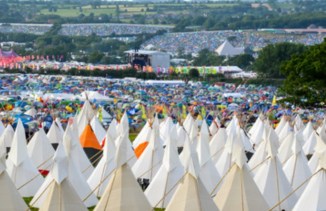
The signs, benches and stages at the festival are flat packed, stored and reused each year. When the new ‘superfence’ was installed in 2002 I found myself walking or driving along corrugated metal pathways in various places on and around the site, particularly those prone to deep mud. The several miles of old fence were reused, and are still in use today. That’s Glastonbury for you!
Only rich people can afford to go
For some time now, the likes of The Guardian have been printing silly articles about celebrities being spotted at Glastonbury, or the latest ‘festival fashion’ – something that only exists in the imagination of the press and not inside the Glastonbury fence. This creates a false illusion, but the facts are that the festival has continued to host a diverse range of people from all walks of life. In fact it simply screams diversity, and I am always intrigued to find myself surrounded by people who I wouldn’t normally come into contact with on a day to day basis.
The tickets cost over £200, as do tickets for the popular Reading and Leeds festivals, and when you consider that at Glastonbury this includes 5 days of merriment and access to over 120 stages, I’d say it’s pretty good value for money.
There are many organisations and charities that offer ways to access the festival as a volunteer. Oxfam are the biggest of these, providing over 2400 volunteers in various roles who enter the site for free in return for working a few shifts. Travellers who used to access the site for free in the early days are now involved in organising the nightclub area in the Southeast corner, and the Greenfields area.
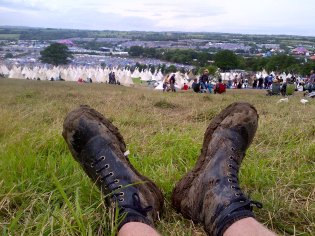
Sometime back in the early nineties I sat in the Stone Circle on a Thursday afternoon, and watched a steady trickle of people somehow appear from the top of the fence and land sprawling with their rucksacks on the ground, to applause from the surrounding festival goers already comfortably installed with their spliffs and cans of beer. At first it all seemed quite harmless and amusing, but it soon turned more sinister when a crowd of people started pulling down parts of the fence, and were joined by others, chanting about a free festival. The mob mentality was quite scary to witness.
When asked about the incident in the Speaker’s Forum later that weekend, Michael Eavis responded that ‘the worst thing you can do for the future of the festival is pull the fence down’, and explained the basic facts of life and festival organisation; Without any control of numbers, the festival would not be granted a licence each year, and would simply cease to exist.
The problem came to a head in the year 2000, with record numbers of gate-crashers causing serious health and safety concerns due to overcrowding. As a result, the Superfence went up in 2002, and would-be gate-crashers were finally thwarted.
To see this as a bad thing is simply pie-in-the-sky nostalgia. The festival has been hugely successful and as a result has grown in size considerably since those heady days of 1970. The idea that it could somehow continue as a free for all is just nonsense.
From where I’m sitting inside the super-fence, things have only improved. Not only is gate-crashing no longer a threat to the licence, but there is now virtually no crime. Gone are the days of living in fear of returning to your field in the early hours of the morning to find your tent has vanished. This used to happen to a significant number of people in the nineties.
The line-up isn’t as good as other festivals
You may have noticed that Glastonbury tickets sell out before the main acts have even been announced. Plus, the vast majority of Glastonbury goers enter the site on Wednesday, even though the main stages don’t kick off until Friday. I think this speaks volumes. That’s two days and two nights at the festival with no bands playing on the main stages. And trust me, we don’t spend that time lying in our tents.
Remind me again who’s headlining this year….
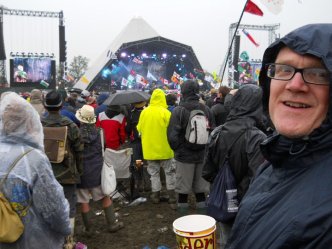
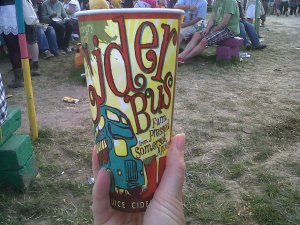
Despite what the dull BBC TV coverage would have you believe, Glastonbury really is about so much more than the main stages. I can’t even begin to describe all the things there are to see and do, and the incredible atmosphere that surrounds it all. This is a small city of weird and wonderful cafes, bars, nightclubs, hidden copses, spontaneous drumming jams around campfires outside teepees, strange constructions from the mind-blowingly gigantic to the hidden wonders, surreal performances, wood fired saunas, mud wrestling, fireworks, circus and craft workshops, poetry recitals, wandering choirs and brass bands, vege pakoras freshly made in a clay oven hidden in the middle of an organic herb and vegetable garden, bicycle powered smoothies, and traditional Somerset cider in biodegradable cups on haystacks served from an old bus….it really has to be experienced to be appreciated.
As the festival newspaper once put it; Sitting at the main stages with a pack of beer is one way to experience the festival. It is the worst.
The toilets are horrific
Actually, this one’s true. But here’s the thing; you spend a tiny fraction of your time in them. The other 99.99999% of your time at the festival will be spent having one of the most unique and amazing experiences of your life. So just deal with it. There are hand sanitizers and/or soap and water at every toilet block, so you can at least go on your way feeling reasonably refreshed, if a little traumatised.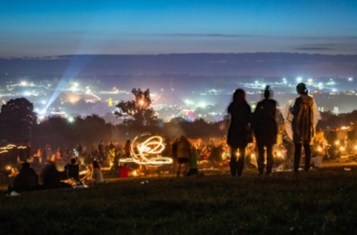
Glastonbury Festival has been a part of my life for so long, and it has been a great pleasure and privilege to watch it grow and evolve over the years, with so many problems encountered and somehow overcome. It really has got better as it has got bigger, and every year I notice something that didn’t go so well last year, being improved on the following year. And yet fundamentally, it has always remained the same.
Thank-you Michael and Emily for hosting the best party on earth!
 Adventures of a middle-aged Morrissey fan